
What Is a Walking Act? Mobile Entertainment That Comes to Your Guests
A walking act moves freely between guests instead of standing on a stage. What that means exactly, why it works, where it fits and how a walking act with magic unfolds – explained concisely.
A walking act is mobile entertainment that moves freely between guests instead of standing on a stage. In the context of magic, this means close-up or table magic on the move: the artist goes from group to group, needs no stage and no technology, and bridges waiting times without disrupting the schedule. It works especially well at drinks receptions, trade fairs, corporate parties, weddings and gala intervals. Around 1.5 to 3 hours is common, during which the act gradually reaches all the guests. Anyone who also wants one clear highlight for everyone combines the walking act with a short stage show.
Walking act: a definition
A walking act is a form of entertainment that does not take place at a fixed spot but moves freely between the guests. Instead of the audience coming to a stage, the artist comes to the people – to the standing table, into the seating group, to the bar. The term therefore describes less a particular art form than a way of performing: mobile, casual and right among the guests.
Walking acts come in many variations – from the stilt figure to the live caricaturist to the musician who moves through the room. What they share is that the act works without a fixed stage and reaches guests where they already are. The following focuses mainly on the walking act with magic, because it is particularly well suited to receptions, trade fairs and celebrations.
The walking act in the context of magic
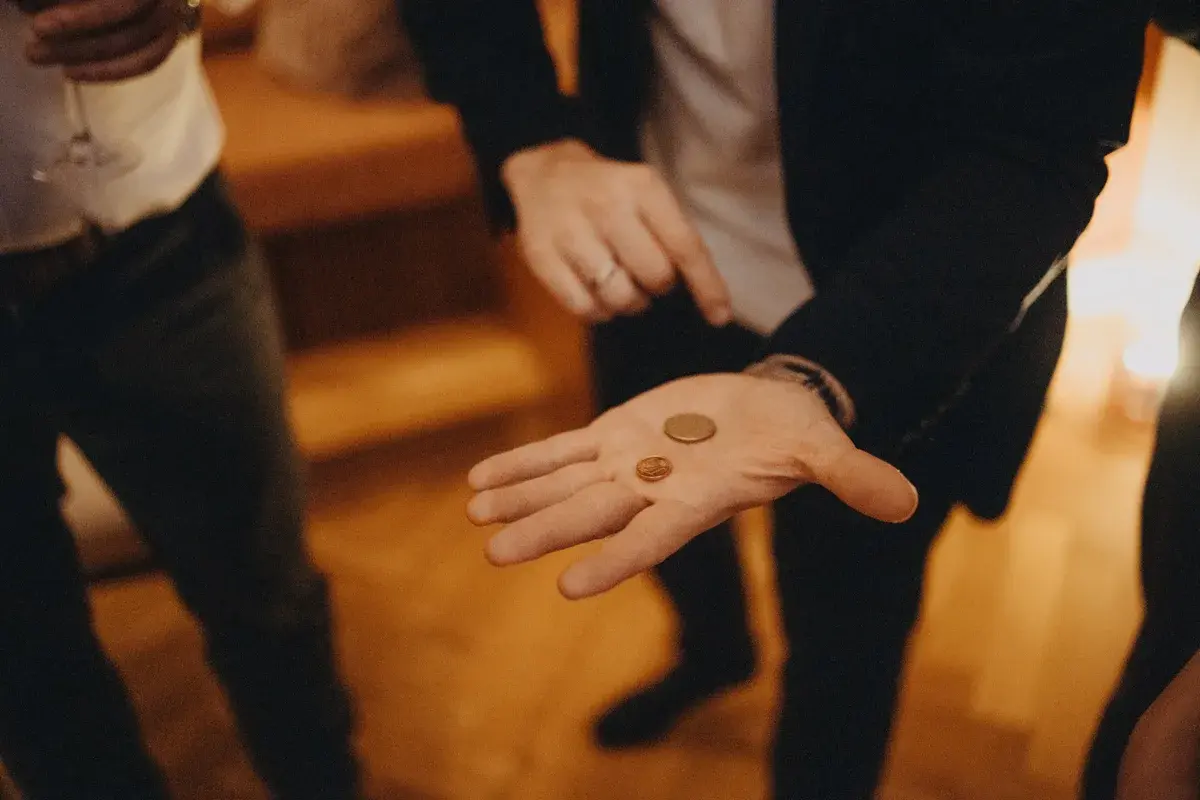
In the field of magic, a walking act usually means close-up or table magic on the move. Close-up stands for magic at the closest range – with cards, coins, rings or borrowed objects, right before the guests’ eyes. In a walking act this form becomes mobile: the artist does not stay at one table but goes from group to group, showing a short, self-contained piece each time.
The difference from classic table magic is fluid. At a seated dinner, the artist goes from table to table; at a standing reception or a trade fair, they move freely between standing tables and small groups. In substance it is the same close-range art – only the choreography in the room differs.
- Close-up: magic at the closest range, with cards, coins and everyday objects
- Mobile: no fixed spot, the artist comes to the guests
- Short units: one self-contained piece of a few minutes per group
Why a walking act works
The strength of a walking act lies in removing the barrier of the stage. No one has to sit down, no one waits for an announcement. Instead, the entertainment happens where the guests already are – as small, surprising moments that carry on from group to group.
It is precisely in the often underestimated idle phases of an event that this takes effect: as guests arrive, before dinner or during a changeover break. Instead of polite small talk about the weather, two strangers suddenly share an experience they can talk about. That is the real value: the walking act gives people a reason to start talking to each other.
- It comes to the guests instead of forcing them onto a stage
- It needs no stage, no lighting and no sound
- It bridges waiting times without disrupting the schedule
- It mixes groups and gets strangers talking
Where a walking act fits
A walking act fits anywhere people stand, wait or move freely – and where a stage is either missing or simply not the right frame. Because it works without set-up and technology, it can be deployed flexibly and at short notice.
It has proven itself especially in these situations:
- Drinks reception: as a gentle start while not all guests have arrived yet
- Trade fair: to approach visitors at the stand and get them talking
- Corporate party: as an icebreaker that mixes departments and hierarchies
- Wedding: during the drinks reception or between programme points
- Gala and show: during the intervals, for example while the stage is being reset
Flow and duration
A walking act does not depend on a fixed performance time. A window of around 1.5 to 3 hours is common, during which the artist gradually reaches all the groups. They usually start where people are already standing and work their way through the room piece by piece – without announcement and without anyone missing out.
Per group, a short appearance lasts only a few minutes. This makes the act easy to fit into an existing schedule: it disrupts no meal, no speech and no stage show, but fills exactly those phases that would otherwise be idle. For larger events, a rough agreement on which areas to cover first is worthwhile.
Walking act vs. stage show
Two formats with different strengths – as orientation for your planning.
| Criterion | Walking act | Stage show |
|---|---|---|
| Location | mobile, between the guests | fixed spot on a stage |
| Attention | small groups one after another | the entire audience at once |
| Technology | no stage, lighting or sound needed | stage, lighting and sound required |
| Duration | approx. 1.5–3 hrs spread over the event | approx. 20–45 min in one go |
| Effect | icebreaker, bridges waiting times | shared highlight for everyone |
| Fits at | reception, trade fair, intervals, standing events | gala, dinner show, corporate party highlight |
When the combination pays off
A walking act and a stage show do not exclude each other – on the contrary, they complement each other well. The walking act catches the guests as they arrive and creates atmosphere while not everyone is there yet. The stage show then sets the shared highlight later that everyone remembers.
The combination pays off above all at larger events with a clear schedule: reception, dinner, highlight. At smaller, casual gatherings or pure standing receptions, the walking act alone is often entirely enough – here a stage would be more of a break in the frame than a gain.
Frequently asked questions about the walking act
What is a walking act, simply explained?
A walking act is mobile entertainment that moves freely between the guests instead of standing on a stage. The artist comes to the people – to the standing table, into the seating group, to the bar. In the context of magic, this means close-up or table magic on the move.
What is the difference between a walking act and table magic?
In substance it is the same close-range art. The difference lies in the movement through the room: with table magic the artist goes from table to table at a seated dinner, whereas in a walking act they move freely between standing tables and small groups, for example at a reception or a trade fair.
How long does a walking act last?
A window of around 1.5 to 3 hours is common, during which the artist gradually reaches all the groups. Per group, a short appearance lasts only a few minutes, so the act fits easily into an existing schedule.
Does a walking act need a stage or technology?
No. A walking act with magic works without a stage, without lighting and without sound. That makes it flexible: it can also be used in rooms or situations where a stage is not possible or not wanted.
Which events is a walking act suited to?
Especially drinks receptions, trade fairs, corporate parties, weddings and the intervals at galas and shows – in other words, anywhere people stand, wait or move freely. You can find out more on the page about the walking act in Berlin.
Walking act or stage show – which is better?
It depends on the occasion. The walking act is the better icebreaker and bridges waiting times, while the stage show sets the shared highlight for everyone. At larger events with a clear schedule, the combination of both formats often pays off.
Related pages & articles
Walking Act Berlin
Mobile magic for receptions & trade shows.
Learn more →Close-up and Table Magic Explained: What Is It Really?
Magic at eye level, right in front of your guests: what defines table magic, how it differs from a stage show, why it works as a walking act – and which occasions it suits best.
Learn more →Trade Show
More visitors for your exhibition stand.
Learn more →Prices & Costs
How much does a magician in Berlin cost?
Learn more →Enquire about a walking act for your event
Tell me briefly about your event – you’ll receive a no-obligation quote, usually within 24 hours.
Check availability