
Close-up and Table Magic Explained: What Is It Really?
Magic at eye level, right in front of your guests: what defines table magic, how it differs from a stage show, why it works as a walking act – and which occasions it suits best.
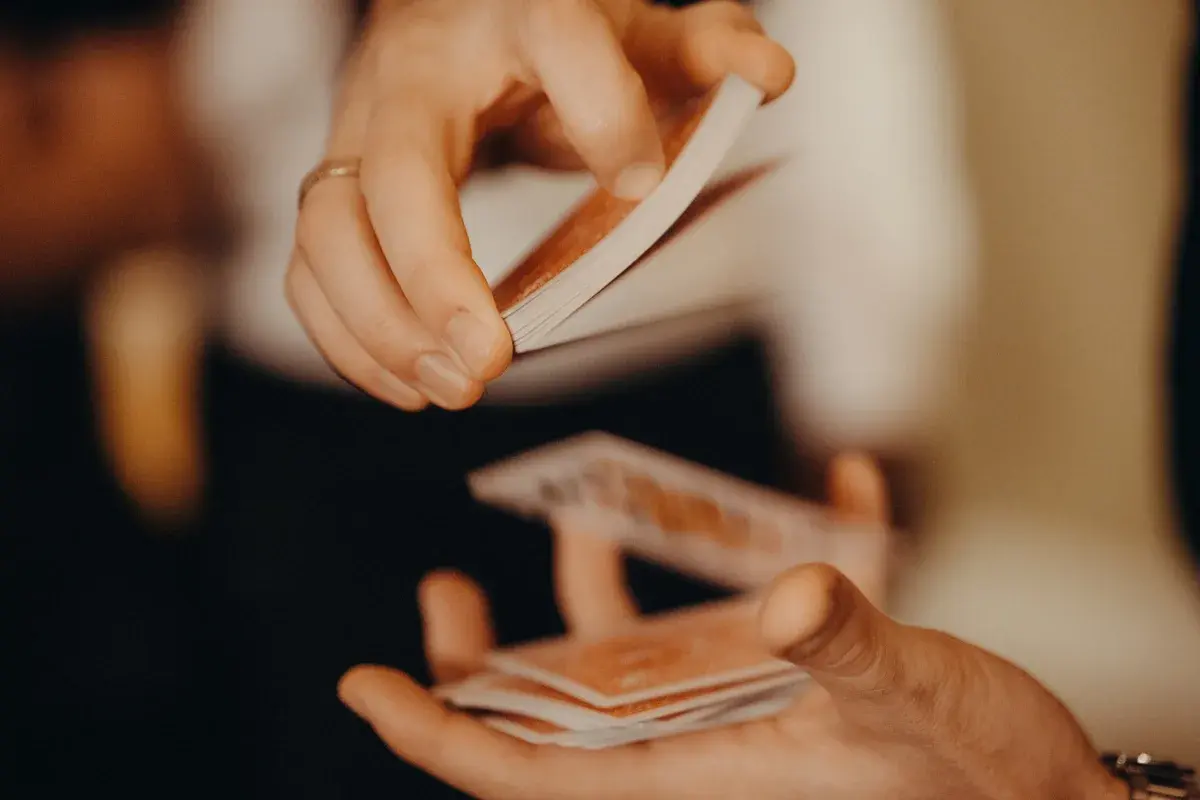
Table magic – often called close-up magic – happens right in front of your guests, at arm’s length and with everyday objects such as cards, coins and rings. Unlike a stage show, it needs no stage, no technology and no fixed seating: the artist comes to the guests as a walking act, from table to table or from group to group. That makes it the ideal entertainment for a reception, corporate event, wedding or dinner – anywhere people are meant to get talking.
What is table magic?
Table magic is magic up close. Instead of a stage a few metres away, the trick happens right in front of your guests – at arm’s length, sometimes even in their own hands. That is exactly why it is internationally known as close-up magic: ‘close-up’ stands for the immediate proximity to the audience.
It works with objects everyone knows: playing cards, coins, rings, banknotes, sometimes a pen or a watch. There are no large props and nothing for the artist to hide behind. This simplicity is the real appeal – when an effect happens with everyday things right before your eyes, you cannot dismiss it with ‘there must have been some gadget involved’.
- At eye level: the trick happens right in front of your guests, not on a stage
- With everyday objects: cards, coins, rings – things everyone knows
- Interactive: guests shuffle, choose, hold on and are part of what happens
Table magic or stage show – what’s the difference?
Both formats are magic, but they work in fundamentally different ways. The stage show is a shared experience for everyone: the audience sits, looks in one direction and experiences one clearly set highlight – ideal after dinner, when all guests have arrived and are meant to settle down.
Table magic turns this around. It comes to the guests rather than calling them over. There is no fixed beginning and no fixed end; the artist moves freely from group to group. That makes it the perfect companion for phases where people are already talking and eating – such as the reception or between courses.
Table magic vs. stage show
Two formats, two purposes – as a rough orientation.
| Criterion | Table magic | Stage show |
|---|---|---|
| Distance | at arm’s length, right at the table | from a few metres away |
| Stage & technology | not needed | stage, lighting and sound useful |
| Flow | free, from group to group | fixed start and highlight |
| Best phase | reception, between courses | after dinner, once everyone’s there |
| Interaction | very high, everyone takes part | occasional, individual volunteers |
Why table magic works as a walking act
A walking act is entertainment that moves. That is precisely the strength of table magic: it needs no stage, no power and no announcement. The artist steps up to a table or a standing group, shows a few tricks and moves on – this way they reach all guests over the course of an evening, without anyone having to leave their seat.
This solves a typical problem at receptions and corporate events: the initial stiffness. When something inexplicable suddenly happens at a standing table, two people who have only just met are suddenly talking about the same experience instead of the weather. Table magic gives guests a reason to start a conversation – and that is often worth more than the effect itself.
- No stage and no technology needed – ready to go in any room
- Comes to the guests rather than tying them to one spot
- Reaches every group over the evening, even with a scattered audience
Typical occasions for table magic
Table magic fits anywhere people come together and are meant to get talking. Because it slots flexibly into the schedule and requires no setup changes, it can be woven almost seamlessly into an existing event plan.
- Reception and welcome drinks, while not all guests have arrived yet
- Corporate event and company party, as an icebreaker between departments
- Wedding, during the couple’s photo shoot or at the welcome drinks
- Dinner and set menu, as a surprise between courses
- Trade fair and product launch, to draw visitors to the stand
How a round of table magic works
A round usually lasts five to ten minutes per table or group. The artist approaches unobtrusively, starts with a small effect and builds up once attention is there. Nobody has to go up on stage, nobody is put on the spot – guests stay sitting or standing where they are.
Interaction is at the heart of it: guests shuffle the cards, choose for themselves, hold coins. It is exactly this taking part that makes the effect so convincing, because guests experience with their own hands that everything is above board – and yet it still cannot be explained. After a few minutes the artist moves on to the next group.
- An unobtrusive start, without interrupting the conversations
- A build-up from a small effect to the highlight of the round
- Active guest participation: shuffling, choosing, holding on
- Moving on to the next group after five to ten minutes
What makes table magic good
The best effect falls flat if guests feel put on the spot. Good table magic therefore lives not only on the tricks, but on the way the artist treats people: warm, humorous and at eye level. Guests should laugh and marvel, not be tested.
Timing matters just as much. Whoever starts gently at the welcome drinks and tactfully slots between courses at dinner blends into the evening rather than interrupting it. Good coordination with the host beforehand – occasion, guest count, schedule – ensures the table magic arrives at exactly the right moment.
- Charm instead of a demonstration: guests are players, not test subjects
- The right timing: during conversation and dining phases, never mid main course
- Coordination beforehand: clarify occasion, guest count and schedule in advance
Frequently asked questions about table magic
What exactly is close-up magic?
Close-up magic is magic up close – right in front of your guests, at arm’s length and with everyday objects such as cards, coins and rings. In German it is known as table magic. The artist comes to the guests as a walking act rather than performing on a stage.
What is the difference between table magic and close-up magic?
They are essentially the same thing. ‘Close-up’ is the international term for magic at immediate proximity, while ‘table magic’ is the common German label – because it often happens right at the guests’ table. Both mean magic at eye level with everyday objects.
Does table magic need a stage or technology?
No. Table magic works without a stage, lighting or sound and is ready to go in any room. That is exactly what makes it so flexible as a walking act: the artist moves freely among the guests, without anything needing to be set up.
Which occasions is table magic suited to?
Especially a reception, corporate event, wedding, dinner and trade fair – anywhere people are meant to get talking. It slots flexibly into the schedule and works best before dinner, at the welcome drinks or between courses.
How long does a round of table magic take per table?
Per table or group it is usually five to ten minutes. The artist then moves on, so that all guests get their turn over the course of the evening. The total duration depends on guest count and format and is agreed in advance.
What does a table magician cost?
Table magic starts at around 500 euros per hour. The price depends on duration, guest count, travel and format. A transparent overview of the pricing factors can be found on the prices page – or simply request a no-obligation quote directly.
Related pages & articles
Table Magician Berlin
Close-up magic right at the guest table.
Learn more →What Is a Walking Act? Mobile Entertainment That Comes to Your Guests
A walking act moves freely between guests instead of standing on a stage. What that means exactly, why it works, where it fits and how a walking act with magic unfolds – explained concisely.
Learn more →Mentalism Explained: Mind Reading as Entertainment Art
Reading thoughts, predicting decisions, seemingly influencing people: what mentalism is, how it differs from classic magic and why it captivates adults in particular – explained honestly, without any esotericism.
Learn more →Prices & Costs
How much does a magician in Berlin cost?
Learn more →Enquire about table magic for your event
Tell me briefly about your occasion – you’ll receive a no-obligation quote, usually within 24 hours.
Check availability