
Gala Evening Entertainment: Ideas and the Right Programme for Every Phase
Whether a corporate gala, a charity gala or a congress evening: a gala thrives on the right dramaturgy. Which entertainment works at the reception, at dinner and as the highlight, how to align it with the schedule, technology and stage – and which mistakes slow the evening down.
A successful gala evening follows a clear dramaturgy: reception, dinner, highlight, wind-down. Each phase calls for different entertainment. At the reception, a walking act with close-up magic opens up the room; at dinner, quiet mentalism creates conversation; and after the meal a stage show or show act sets the shared highlight. What matters is not as much programme as possible, but the right act at the right time – cleanly aligned with the schedule, technology and stage.
The dramaturgy of a gala evening
A gala evening is not one loose programme point after another, but a considered sequence. Whether a corporate gala, a charity gala or the evening event of a congress – almost every gala follows the same basic structure: reception, dinner, highlight, wind-down. Anyone who knows these four phases can place entertainment exactly where it works, instead of scattering it across the evening.
The mistake of many galas is not too little programme, but too much at the wrong time. A strong show act fizzles out if it runs during the reception while guests are still arriving and looking for familiar faces. Conversely, close-up magic at the table feels lost when everyone should be watching the stage. The art lies in giving each phase the entertainment that fits its mood.
- Reception: arriving, drinks reception, first conversations – relaxed, mobile entertainment
- Dinner: eating and exchange at the table – quiet, discreet accents
- Highlight: the shared moment for everyone – one clear show act on stage
- Wind-down: music, bar, networking – no fixed programme needed any more
Drinks reception: walking act and close-up as the door opener
The reception decides the mood of the whole evening. Guests arrive in waves, stand in small groups with a glass in hand and often only partly know each other. This is exactly the most critical phase: if it stays at polite small talk, the initial stiffness carries through the evening.
A walking act with close-up magic dissolves this without feeling intrusive. The artist moves freely between the standing tables, goes from group to group and needs neither a stage nor an announcement. When a trick suddenly happens at one table, a shared moment is created – and two guests who have only just introduced themselves are suddenly talking about the same experience. That is the real value at the reception: it gives people a reason to start a conversation.
- Without a stage and without an announcement – adapts to guests arriving
- Mixes little groups and breaks the initial stiffness
- Ideal in the first half hour to hour, while not everyone has arrived yet
At dinner: quiet mentalism instead of a big show act
During dinner, attention is on the food and on conversation at the table. A loud show act would be out of place here – it would interrupt the meal and compete with the conversations. Entertainment at dinner should accompany, not drown out.
Mentalism is especially suited to this. It works without large props, functions in small rounds at the table and gives guests something to talk about between courses. Timing is key: never in the middle of a course, but in the breaks, when the plates are cleared and there is time before the next course. That way dinner stays a quiet part of the evening and still gets a special accent.
- Discreet and close to the table, without technology and without a big stage
- Only in the breaks between courses, never during the meal itself
- Provides conversation rather than interrupting the table talk
Programme phase, suitable act and effect
Which entertainment works in which phase of the gala evening – as orientation for planning.
| Programme phase | Suitable act | Effect |
|---|---|---|
| Drinks reception | Walking act / close-up magic | icebreaker, guests start talking |
| Dinner (between courses) | Mentalism at the table | discreet accent, conversation |
| Highlight after dinner | Stage show / show act (20–30 min) | shared moment for everyone |
| Transitions & hosting | Hosting / short introductions | common thread, clear schedule |
| Wind-down | Music / bar, no fixed programme | relaxed networking |
The highlight: stage show and show act after dinner
Every gala needs a moment everyone remembers. This highlight is best placed after dinner, when guests are full, relaxed and ready to watch the stage together. A stage show of 20 to 30 minutes sets this point – it gathers the whole room around one shared experience instead of many parallel table conversations.
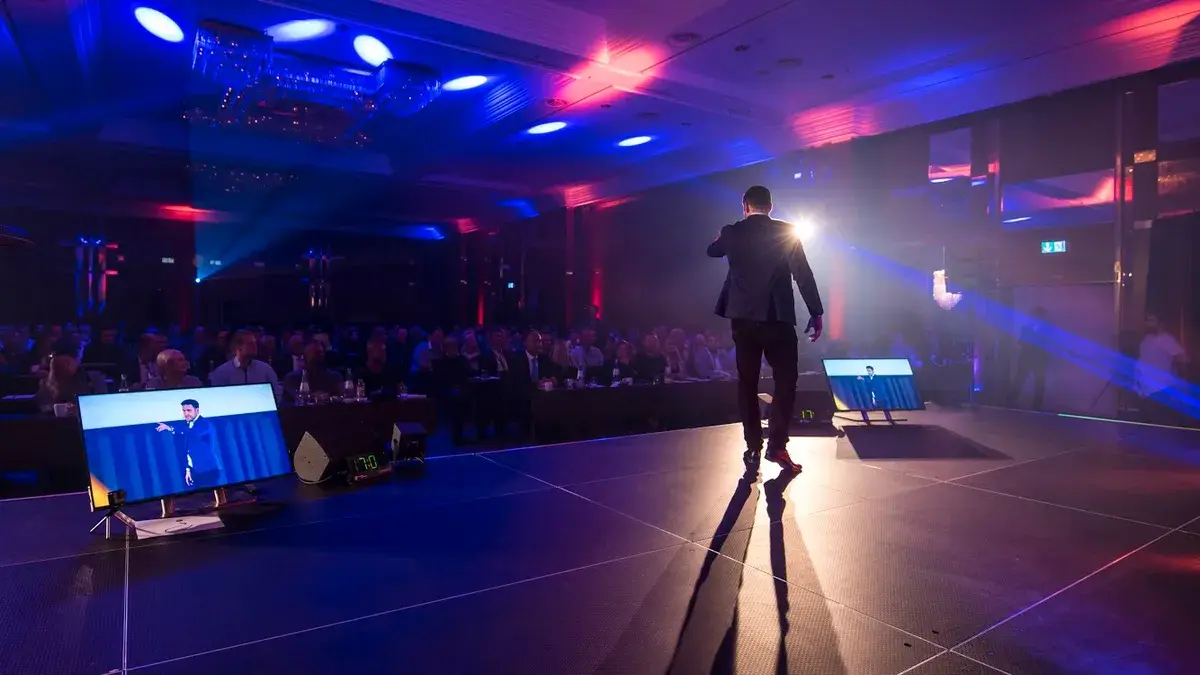
A good show act for a gala combines visible magic with clear dramaturgy: a calm start, a build-up and a strong finale. Alignment with the stage is important. It needs a spot where everyone can see well, working sound and suitable lighting. Anyone using a walking act across the evening can lead it towards the highlight: first close-up at the reception, then the stage show as the climax. You’ll find more on the stage format on the stage show page and in the guide to the walking act in Berlin.
- Place it after dinner, when attention is focused
- 20 to 30 minutes with a clear build-up and a strong finale
- Align stage, sound and lighting early – the highlight must not fail on technology
Aligning with schedule, technology and stage
For each act to come at the right time, the entertainment has to be embedded in the overall schedule. Talk early with the director or event team about where the free phases are and when other programme points – speeches, awards, donation appeals at a charity gala – take priority. Two highlights at once weaken each other.
Technology and stage decide the effect. A stage show needs a stage with a good viewing angle, clean sound and lighting that carries the artist. A walking act, by contrast, needs almost nothing – but it needs room to move between the tables. Hosting holds the evening together, announces the highlight and ensures the transitions do not feel bumpy. The earlier these points are clarified, the smoother the evening runs.
- Clarify with the director: where are the free phases, where do speeches and awards take priority?
- Stage show: check and set up stage, sound and lighting early
- Walking act: ensure freedom of movement between the tables
- Involve hosting: lead the transitions and introduce the highlight
Common mistakes – and how to avoid them
- Too much programme: breaks and free conversation time are underestimated
- Act too long: a stage show over 30 minutes tires the audience
- Wrong timing: a big show act at the reception fizzles out because not everyone has arrived
- Entertainment during the meal: disturbs the table talk and the enjoyment
- Two highlights in parallel: the show and speeches compete with each other
- Technology neglected: poor sound or sightlines ruin even the strongest act
Frequently asked questions about gala evening entertainment
Which entertainment suits a gala evening?
It depends on the phase. At the drinks reception a walking act with close-up magic works, at dinner quiet mentalism between courses, and after the meal a stage show or show act as the highlight. Hosting holds the evening together.
When should the highlight of a gala evening take place?
Best after dinner, when guests are relaxed and ready to watch the stage together. A stage show of 20 to 30 minutes then sets a moment everyone remembers.
How long should a show act at a gala be?
For the highlight, 20 to 30 minutes is ideal. Longer acts tire the audience, especially after a multi-course dinner. A walking act across the evening, by contrast, runs flexibly for one to two hours, spread across the reception and free phases.
Does magic also suit a charity gala or a congress evening?
Yes. At a charity gala the highlight pairs well with the donation moment, and at a congress evening a walking act loosens up the formal setting. What matters is aligning it with speeches and awards so the highlights do not overlap.
What does entertainment for a gala evening cost?
A walking act with close-up magic starts at around 500 euros per hour, a stage show from 1,200 euros. The price depends on duration, guest count and format. A transparent overview of the pricing factors can be found on the prices page.
How far in advance should you enquire about entertainment for a gala?
For sought-after dates in autumn and December, it is worth enquiring several months ahead. For other dates, a few weeks are often enough. Better to ask once too often – short-notice dates are sometimes still possible.
Related pages & articles
Stage Show & Gala
Big show for gala & conference.
Learn more →Walking Act Berlin
Mobile magic for receptions & trade shows.
Learn more →What Is a Walking Act? Mobile Entertainment That Comes to Your Guests
A walking act moves freely between guests instead of standing on a stage. What that means exactly, why it works, where it fits and how a walking act with magic unfolds – explained concisely.
Learn more →Prices & Costs
How much does a magician in Berlin cost?
Learn more →Secure the programme for your gala evening
Tell me briefly about your gala – you’ll receive a no-obligation quote, usually within 24 hours.
Check availability