
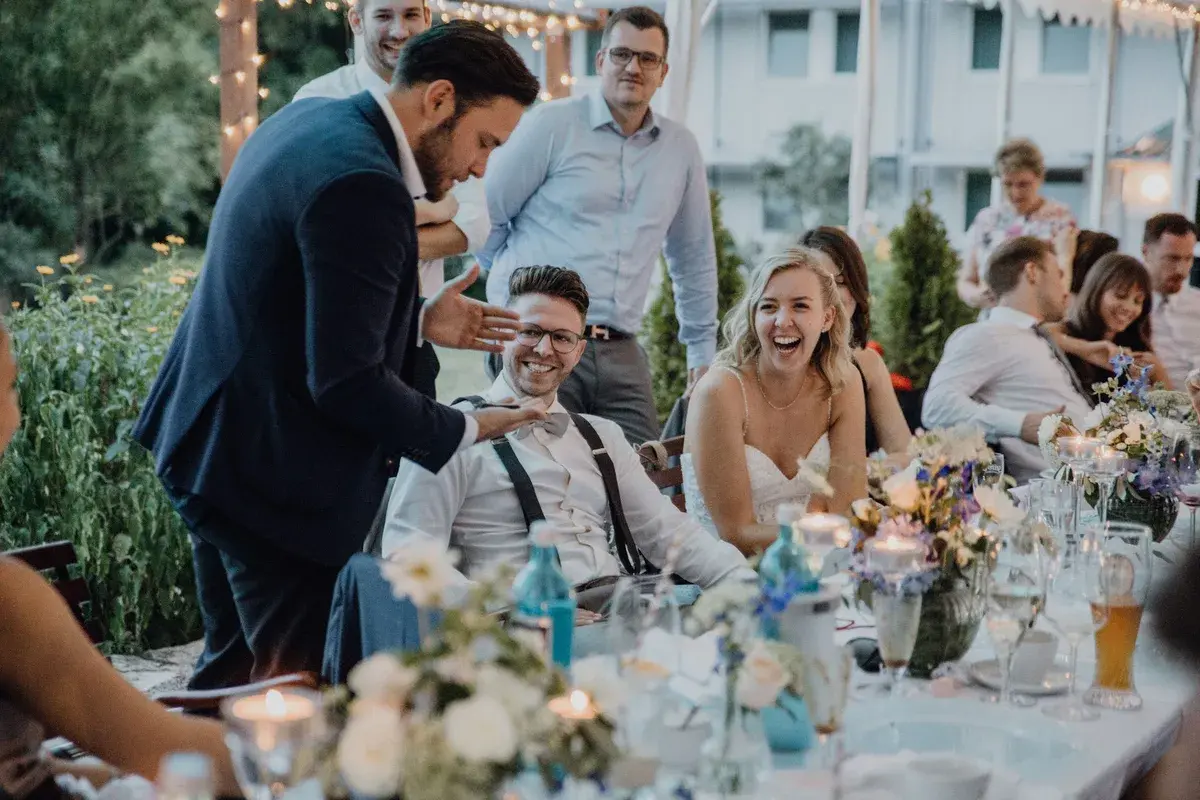
Wedding Entertainment Ideas: Involve Your Guests and Bridge the Waiting Times
Which entertainment suits which phase of the wedding day? An overview of formats that involve guests of every generation, fill lulls – such as during the couple’s photo shoot – and what to keep in mind when you plan.
Good wedding entertainment doesn’t just play in the background – it involves your guests and bridges the waiting times that arise on almost every wedding day, the couple’s photo shoot above all. It works best as a mix of a few well-timed formats: something connecting at the reception, a calm companion at dinner and a shared highlight in the evening. Magic is one option among several here – what matters is that the entertainment fits each phase and every generation, and that awkward forced games stay out of it.
What good wedding entertainment should achieve
A wedding is not a show where guests merely watch. They come together from different circles – family from one side, friends from the other, colleagues, neighbours – and often barely know each other. You can tell good entertainment by the fact that it involves these people and gets them talking, rather than just playing in the background. That rarely works with a single big programme point, but with a handful of formats that suit the respective phase of the day.
The second task is unspectacular but decisive: bridging waiting times. Between the ceremony, reception, dinner and dancing, gaps almost inevitably arise in which the mood stalls. The longest of these is usually the couple’s photo shoot – often the best part of an hour in which guests are left to their own devices. Planning these phases deliberately prevents a lull without overloading the day with programme.
- Involve rather than entertain passively: guests become part of what happens
- Fill waiting times: above all during the couple’s photo shoot
- Connect generations: one thread for grandparents and children alike
The formats at a glance: from walking act to photo booth
There is no single right wedding entertainment. It makes more sense to pick two to four formats that complement each other and can be spread across the day. The ideas below have proven themselves at weddings of different sizes – each covers a different phase and a different need.
Some formats accompany the day in passing and need no attention, while others set a clear highlight. Table magic as a walking act is an example of the first kind: the artist moves freely from group to group, needs neither a stage nor an announcement and fills exactly the waiting times where a lull would otherwise arise. If you’d like to go deeper into this format, you’ll find details in the guide to the table magician in Berlin.
- Table magic as a walking act: flexible, no stage, ideal for the reception and waiting times
- Live music or a DJ: a backdrop during the day, dancing in the evening
- A photo booth or instant prints: a keepsake guests create themselves
- Mentalism at dinner: calm rounds between courses that captivate rather than disturb
- Games in moderation: short, voluntary and easy for everyone to follow
- A short stage show in the evening: a shared highlight for all guests
Bridging waiting times – the photo shoot above all
The most critical phase is rarely planned: as soon as the couple disappears for the photo shoot, guests are often left to their own devices for the best part of an hour. Without a reason to talk, they stay in their familiar little groups, and the mood the reception built up noticeably fades. This is exactly where entertainment pays off that works without a stage and without an announcement.
Table magic as a walking act suits this especially well, because it comes to the guests instead of bringing them to it. When a trick suddenly happens at a standing group, a shared moment arises – and two people who barely know each other are suddenly talking about the same experience. A photo booth, where guests become active themselves, or quiet live music that carries the room work just as well. The one thing that matters: this phase must not be left unused.
- A plan for the couple’s shoot: the longest and most important waiting time
- Prefer formats without a stage: walking act, photo booth, unobtrusive music
- Keep the transition seamless: entertainment starts before a lull arises
Phase of the day and matching entertainment
Which format suits which phase – as orientation for your planning.
| Phase of the day | Matching entertainment | Effect |
|---|---|---|
| Reception drinks | Walking act, quiet live music | icebreaker, relaxed conversation |
| Couple’s photo shoot | Walking act, photo booth | bridge the guests’ waiting time |
| Dinner between courses | Table magic, mentalism at the table | entertainment without disturbing the meal |
| Evening after dinner | short stage show, then DJ/dancing | shared highlight, transition to the party |
What connects the generations
At hardly any celebration do such different age groups sit together as at a wedding: grandparents, parents, the couple’s friends and often children too. Entertainment that appeals to only one group leaves the others out. The strongest formats are therefore those that work without prior knowledge and put no one on the spot.
Table magic and mentalism have an advantage here: they demand no stage presence from the guests but invite everyone to wonder – that works for the eight-year-old niece just as well as for the grandfather. A photo booth or well-chosen music also connect generations, as long as they don’t serve a single style. Avoid formats that only insiders understand or that force individual guests to take part.
- Understandable without prior knowledge: no one has to “get it” to have fun
- Voluntary rather than forced: no performances against a guest’s will
- A broad music selection: not just one style or one decade
Timing across the wedding day
Even the best format only works when it comes at the right time. Spread the entertainment deliberately across the day instead of packing it all into one block: a connecting start at the reception, a calm companion at dinner and a clearly set highlight in the evening. During the meal itself, during speeches and during the first dance, the programme should pause – two highlights at once only compete with each other.
Agree the schedule early with the venue, the photographer and the witnesses. The photographer knows when the shoot falls; the witnesses often know the schedule better than the couple themselves and can steer at short notice when the right moment has come. Also plan a buffer: a wedding almost always shifts by ten to twenty minutes, and good entertainment reacts flexibly to that rather than working through a rigid plan.
- Spread it across the day: reception, dinner, evening instead of one single block
- Respect the pauses: no programme during the meal, speeches and the first dance
- Coordinate early: involve the venue, photographer and witnesses
- Plan a buffer: the schedule almost always shifts
What you should avoid
- Awkward forced games: anything that puts guests or the couple on the spot
- Too much programme: pauses and conversation time are regularly underestimated
- Entertainment during the meal: guests focus on their plates and the table conversation
- Leaving the waiting time unused: the photo shoot runs without a programme and a lull arises
- Serving only one generation: music or formats that leave half the tables out
- Booking too late: popular Saturdays in the season are taken early
Frequently asked questions about wedding entertainment
Which entertainment suits a wedding best?
A mix of a few well-timed formats: something connecting at the reception, a calm companion at dinner and a shared highlight in the evening. Table magic, live music, a photo booth or a short stage show complement each other well. What matters is that the entertainment involves guests rather than just playing in the background.
How do I bridge the waiting time during the couple’s photo shoot?
With formats that work without a stage and without an announcement and come to the guests. Table magic as a walking act, a photo booth or unobtrusive live music fill exactly that best-part-of-an-hour when guests would otherwise be left to their own devices. The key is that the entertainment starts before a lull arises.
How do I involve all the generations?
Rely on formats that are understandable without prior knowledge and force no one to take part. Table magic and mentalism invite everyone to wonder, from children to grandparents. For music, a broad selection helps rather than a single style. Avoid insider formats that only one group understands.
When should the entertainment happen during the wedding?
Spread it across the day: a connecting start at the reception, calm rounds between courses at dinner and a highlight in the evening after the meal. During the meal itself, during speeches and during the first dance the programme should pause, so two highlights don’t compete with each other.
Which wedding games should you avoid?
Anything that puts guests or the couple on the spot or forces individuals to take part. Awkward forced games stay in many people’s memory in an unpleasant way. Better are short, voluntary programme points that everyone can follow, or formats that work without the guests having to perform.
What does wedding entertainment cost?
Table magic starts at around 500 euros per hour, a stage show from 1,200 euros. Other formats such as music or a photo booth depend on the provider and the duration. The price depends on the format, duration and guest count. A transparent overview of the pricing factors can be found on the prices page.
Related pages & articles
Wedding
Wedding magician for your special day.
Learn more →A Magician for Your Wedding in Berlin: the Right Moments and a Smooth Schedule
A magician at a wedding bridges waiting times, gets guests talking and creates shared memories. When it pays off, which moments fit and how to integrate the entertainment cleanly into the day.
Learn more →Table Magician Berlin
Close-up magic right at the guest table.
Learn more →Prices & Costs
How much does a magician in Berlin cost?
Learn more →Secure entertainment for your wedding
Tell me briefly about your wedding day – you’ll receive a no-obligation quote, usually within 24 hours.
Check availability