Book a Magic Show: What Really Makes a Good Stage Show
Before you book a magic show, it helps to know what carries a stage show: interaction rather than big props, the right moment, and a realistic sense of what the stage needs. This guide gives you orientation.
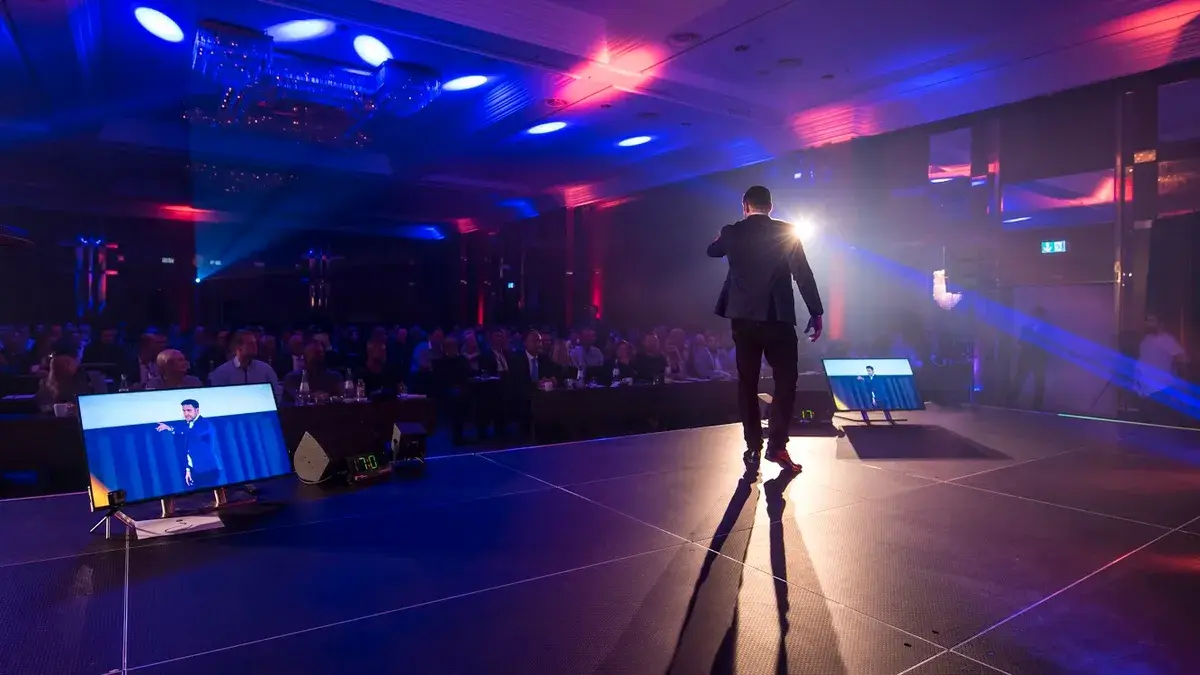
A good stage show does not rely on large props but on interaction and a clear dramatic arc. My stage act is grounded in mentalism – mind reading, predictions and moments where the audience itself becomes the centre – and works entirely without sawn-in-half assistants. As a highlight of 20 to 30 minutes, the show works best after dinner, when attention is free. It scales from an intimate group to around 2,000 guests; from roughly 40 to 50 people, sound and usually lighting make sense. Anyone who also wants to liven up the reception combines the stage show with close-up magic at the tables.
What makes a good stage show
When people want to book a magic show, many first think of large apparatus and spectacular props. In practice, though, something else decides a stage show: whether the audience feels involved or merely watches. A good show builds tension, gives guests a reason to think along and delivers moments people still talk about the next day.
That is exactly what my stage programme is built for. Instead of big props, I rely on interaction and a clear dramatic arc – guests are not spectators on the sidelines but become part of the show. That carries a performance more reliably than any set piece, and it suits an adult audience that wants more than simple amazement.
Mentalism rather than grand illusion
My stage act is grounded in mentalism. That means mind reading, predictions, seemingly impossible matches – magic that happens in the guests’ minds, not in a box on the stage. I deliberately do without grand illusions, cages and sawn-in-half assistants. This kind of magic feels more personal and can be shown against any backdrop, because it works with the people in the room rather than with tonnes of equipment.
The advantage for your event: the act is close, surprising and different every time, because it responds to how the guests react. No two performances are alike. And because no large props need to be transported and set up, the show stays flexible – even in rooms where a classic illusion show would not be possible at all.
- Mind reading and predictions where guests themselves become the centre
- Interaction rather than passive viewing – the audience thinks and guesses along
- No grand illusions, no cages, no sawn-in-half assistants
- For adult and mixed adult audiences, in German or English
The right moment: a highlight after dinner
A stage show needs the guests’ full attention – and that is not available at every point of an evening. The show works best as a highlight after dinner, when no one is waiting for the next course and the room settles. During the main meal, attention belongs to the plate and the conversation at the table; a show here would disrupt rather than shine.
Around 20 to 30 minutes in one block has proven itself as a format. That is long enough for a real dramatic arc and short enough to keep the energy up without overloading the programme. It is worth agreeing briefly on when exactly the show sits – for example after dessert, before the free celebration, or as a transition into the later evening.
From an intimate group to 2,000 guests
A stage act grounded in mentalism scales remarkably well. In an intimate group of 20 or 30 people, an almost private closeness develops, with individual guests drawn in very directly. In front of a larger audience the dynamic changes – but the interaction remains, because the principle can be carried across many people at once.
At the upper end the show holds up to around 2,000 guests, for example at corporate events or galas. What matters then is less the act itself than the technical setting: beyond a certain size, everyone needs to see and hear the show well. That is exactly what the next section is about.
What the stage needs – by guest numbers
Guide values for sound, lighting and stage. The exact need depends on the room and venue.
| Guest numbers | Sound | Stage & lighting |
|---|---|---|
| up to approx. 40 | usually possible without equipment | no stage needed, existing lighting is enough |
| approx. 40–100 | microphone and small system advisable | a slightly raised spot, good general lighting |
| approx. 100–300 | radio microphone and PA required | stage and directed lighting recommended |
| approx. 300–800 | professional sound equipment needed | stage, spotlight and often screen with camera |
| approx. 800–2,000 | stage sound with technical crew | large stage, lighting and screen relay |
Combining the stage show with close-up
The stage show does not have to stand alone. An evening comes together especially well when close-up magic fills the reception or the time before dinner and the stage show later sets the shared highlight. At the reception I go from group to group and show magic right in the guests’ hands – as an icebreaker while not everyone has arrived yet. This is my speciality and the ideal complement to the stage.
Conversely, the mentalism-based stage show can be added as a highlight to a booked close-up performance. This creates an arc across the whole evening: close and personal at the reception, shared and pointed on stage. What makes more sense for your occasion is quickly clarified in a short conversation.
Frequently asked questions about booking a magic show
What makes a good stage show?
Not the size of the props but interaction and dramatic structure. A good stage show involves the audience and delivers moments people still talk about. My act is grounded in mentalism – mind reading and predictions rather than grand illusions.
Can I book a magic show without any grand illusions?
Yes, that is exactly what my programme is built for. The stage act works with mentalism and interaction, not with cages or sawn-in-half assistants. That feels more personal and can be shown against any backdrop and in almost any room.
How long should a stage show be and when does it take place?
Around 20 to 30 minutes in one block is ideal – long enough for a dramatic arc, short enough to hold the energy. The show works best as a highlight after dinner, when attention is free. During the main meal, attention belongs to the food.
For how many guests is the show suitable?
From an intimate group of about 20 people to around 2,000 guests at corporate events and galas. From roughly 40 to 50 guests, sound and usually lighting make sense; from several hundred, a stage and screen relay are added so everyone can see and hear well.
What does it cost to book a magic show?
A stage show starts at around 1,200 euros, and close-up or table magic at about 500 euros per hour. The final price depends on duration, guest numbers, technology and travel. You will find a full overview of the factors on the pricing page.
Can the stage show be combined with close-up magic?
Very much so. Close-up at the reception breaks the ice, and the stage show later sets the shared highlight. Both directions are possible: close-up can be added to the stage show and vice versa – creating an arc across the whole evening.
Related pages & articles
Enquire about a magic show for your event
Tell me briefly about your event – you’ll receive a no-obligation quote, usually within 24 hours.
Check availability